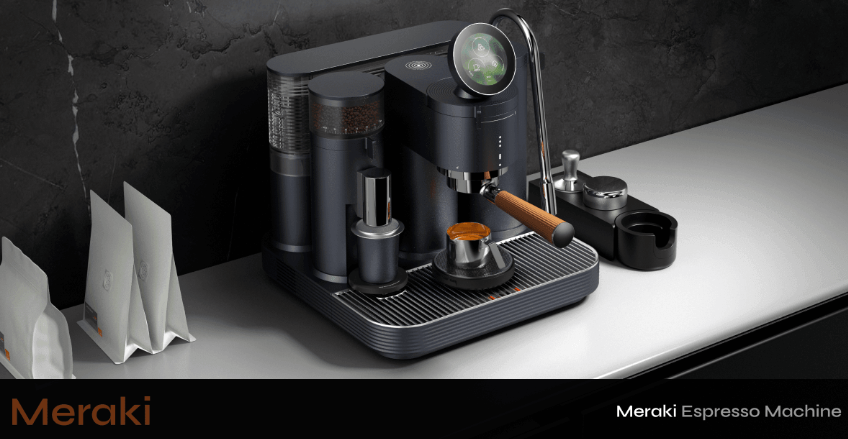
Open a bag of specialty beans and you will usually find a story on the label: origin, roast date, tasting notes, and a suggested recipe. Most of that information never reaches the espresso machine. The drinker reads it, tries to remember it, and translates it into grind and dose settings by hand. Bean recognition is an attempt to close that gap, so the bag itself can tell the machine something useful before the first shot is pulled.
The idea is simple, even if the engineering behind it is not. A small NFC tag on the bag carries a set of brewing parameters chosen for those beans. Hold the bag near the reader, and the machine loads those parameters instead of asking the drinker to enter them. It is less like a barcode at a checkout and more like a recipe card that the machine can read directly. The drinker still decides what to brew, but does not have to start from a blank page every time a new bag arrives.
What NFC Actually Does
NFC, or near-field communication, works over a very short distance. That limitation is a feature here, not a flaw. The tag has to be close to the reader to be scanned, which means the machine is reading the bag in your hand, not a bag across the room. The tag itself is passive, with no battery, and it stores a small amount of data rather than a full database. That is enough for a recipe: grind setting, dose, target weight, temperature, and perhaps a note about the roast.
When the tag is read, those values become the starting point for the shot. If the beans are a light roast that needs a finer grind and a longer extraction, the machine can start there. If they are a darker roast that extracts more easily, it can start gentler. The drinker can still adjust, but the first shot is no longer a guess based on a label read in a hurry. For households that switch beans often, that starting point saves both coffee and patience.
It is worth being clear about what NFC does not do. It does not taste the coffee. It does not know how old the beans are after opening, how they were stored, or whether the bag has been open for two days or two weeks. It cannot judge freshness, and it cannot replace a drinker who notices that a shot tastes sour or bitter and changes the grind in response. The tag gives a sensible recipe. The drinker still provides the judgement.
What the Machine Changes — and What It Leaves Alone
A good implementation changes only what the recipe requires. Grind size is the most obvious example, because different beans and roasts need different particle sizes to extract evenly. Dose and shot weight matter too, since a recipe built around a 1:2 ratio will taste different from one built around a longer ratio. Temperature is another variable, though the range for espresso is narrow, and small changes there can shift sweetness and acidity.
What should not change is the drinker’s control. A system that locks every setting would feel less like help and more like a vending machine. The useful version loads a recipe, shows it clearly, and lets the drinker edit it. If a shot tastes too sharp, the grind can go finer. If it tastes flat, the ratio can be stretched. Those edits can then become the drinker’s own version of the recipe, rather than a one-time fix that has to be repeated tomorrow.
This balance matters most for beginners. A new drinker often does not know whether a bad shot came from grind, dose, temperature, or stale beans. Starting from a recipe designed for that specific bag removes one source of confusion. The remaining variables are easier to learn, one at a time, because the baseline is no longer random.
Beans, Tags, and Freshness
Bean recognition only works well when the beans themselves are well chosen. A tag on a stale or poorly roasted bag will still produce a recipe, but no recipe can rescue coffee that has lost its aromatics. That is why freshness remains the first rule, tag or no tag. Buy in smaller amounts, store beans away from light and heat, and use them within a few weeks of roasting. The machine can optimise extraction, but it cannot create flavour that is no longer there.
For drinkers who want beans matched to the system, Meraki coffee is the natural place to look, since those beans are sold with the tag system in mind. That does not mean other beans are off limits. It means the smoothest experience — tag, recipe, and result lining up — is most likely when the bag and the machine were designed together. Many drinkers will mix tagged bags with untagged favourites, using the recipe as a guide for one and manual settings for the other, and that flexibility is part of the appeal.
How to Get the Most From It
The best way to use bean recognition is to treat the loaded recipe as a hypothesis, not a verdict. Brew it once, taste carefully, and note what you would change. Is the body thin? Try a finer grind. Is the finish harsh? Try a slightly lower temperature or a shorter ratio. Keep a short note, even in your phone, of what worked for each bag. Over time, you build a personal library that is more valuable than any single tag, because it reflects your taste, your water, and your machine.
For a fuller technical overview, see Meraki CoffeeSense, which explains the system in the company’s own terms. The key takeaway is modest and useful: NFC does not make espresso automatic, and it does not need to. It removes a repetitive step — translating a label into settings — so the drinker can spend attention on the part that actually matters, which is how the coffee tastes in the cup.
Used that way, bean recognition is not a gimmick. It is a small piece of good design: information travelling from the bag to the machine, instead of getting lost on the way to the grinder. The morning still belongs to the drinker. The machine just starts a little closer to the right answer.